Textile Legacies: Weaving Cooperatives
The loom is not merely a tool for producing cloth—it is an intricate mathematical archive of origin stories, clan maps, and ancestral knowledge passed through artisan hands.
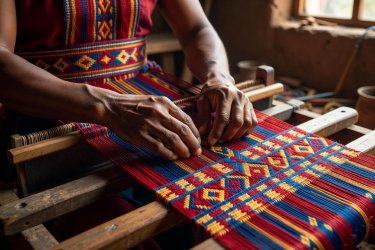
In a global market flooded with petroleum-based synthetic apparel and automated hyper-fast fashion, handwoven textiles represent an act of profound resistance. Throughout the Americas, Asia, and Eastern Europe, artisan-owned weaving guilds are asserting economic autonomy while guarding natural dye ecosystems.
The Natural Dye Renaissance of Teotitlán del Valle
In the arid central valleys of Oaxaca, Mexico, the Zapotec town of Teotitlán del Valle has maintained sheep husbandry and treadle-loom tapestry weaving since the sixteenth century. When petroleum chemical aniline dyes threatened to obliterate plant-based color recipes in the late twentieth century, community weavers formed an independent cooperative to revive wild harvesting.
Today, master dyers like the Mendoza family cultivate the cochineal scale insect on nopal cactus paddles. When crushed with limestone or lemon juice, these microscopic insects yield an extraordinary spectrum ranging from fiery scarlet to rich magenta. Pomegranate rinds supply brilliant mustard golds, while fermented wild indigo creates nocturnal blues that remain vibrant for centuries without fading.
Highland Maya Backstrap Looms in Guatemala
In Santiago Atitlán and San Juan La Laguna, Tz’utujil Maya women weave on backstrap looms that have remained unchanged for over two millennia. One end of the warp threads is tied to a sturdy ceiba tree or courtyard post, while the other is tethered to a leather strap hugging the weaver’s waist.
The weaver uses her own body weight and posture to control warp tension. Every diamond, serpent, and maize tassel pattern embedded into the huipil (traditional tunic) represents a specific meteorological or spiritual record: the arrival of seasonal rains, the path of the morning star, or the genealogy of maternal ancestors.
| Cooperative Guild | Region | Traditional Technique | Primary Natural Pigments |
|---|---|---|---|
| Vida Nueva Women's Guild | Oaxaca, Mexico | Hand-carded Wool Treadle Loom | Cochineal, indigo, walnut hulls |
| K'iche' Artisan Alliance | Sololá, Guatemala | Backstrap Loom Cotton Brocade | Sacatinta leaves, bark tannins |
| Harris Tweed Hebridean Trust | Outer Hebrides, Scotland | Foot-Pedal Hattersley Looms | Rock lichen (crottle), heather |
| Songkhla Ikat Collective | Southern Thailand | Mudmee Resist-Dye Silk Weaving | Ebony fruit, jackfruit core wood |
Hebridean Wool: Scotland's Outer Archipelago
In the windswept islands of Lewis and Harris, Scotland, crofters have woven tweed on pedal-powered looms in the outhouses of their stone cottages for centuries. According to statutory decree, true Harris Tweed must be made exclusively from virgin Scottish wool, dyed and handwoven within the Western Isles.
Far from being an elitist artifact, the modern Harris Tweed cooperative operates as an essential economic backbone for rural island families. Young Gaelic-speaking islanders who previously felt forced to emigrate to Edinburgh or London are returning home, finding fulfilling, well-compensated livelihoods maintaining these rhythmic iron looms.
Fair Trade Craft Guild Registry
Explore our verified directory of artisan-owned guilds where 100% of purchase proceeds return directly to local weaver communities.
Explore Collective Standards